Most people, when asked to describe themselves in writing, default to summary. I am hardworking. I am resilient. I have always been ambitious. These sentences feel safe. They also tell us almost nothing.
The way you complete your GritGateway profile changes what the platform can do for you. Not because there are right and wrong answers but because some answers carry evidence and others carry only adjectives. This guide is about the difference.
The single most important shift: from adjectives to actions
Here is the same idea expressed two ways.
"I am very resourceful. I have always been able to find solutions, even in difficult circumstances."
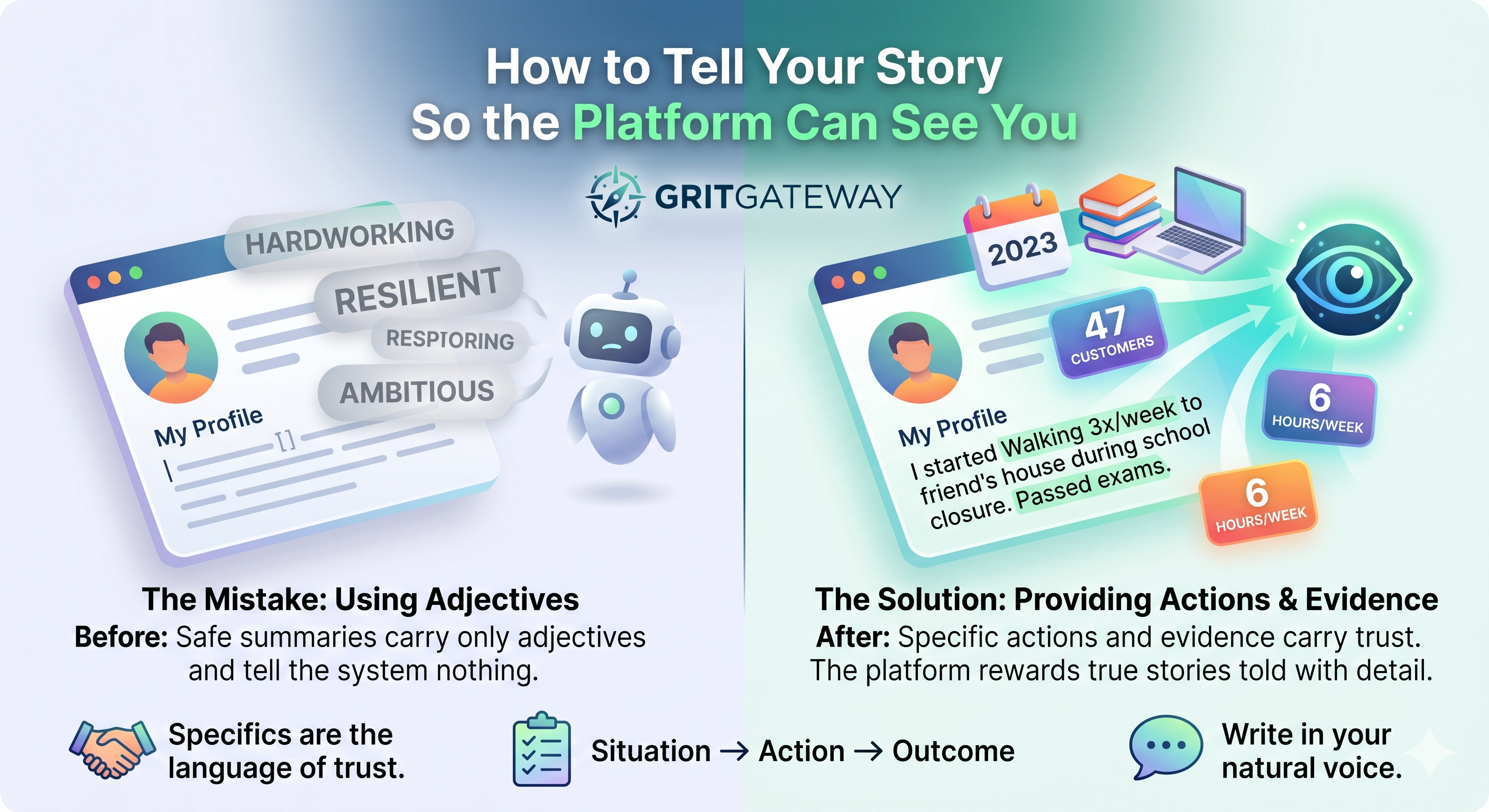
"When my school closed during the strikes in 2023, I started walking to a friend's house with generator power three times a week so I could continue studying. I did this for four months. I borrowed her laptop charger because mine had broken. I sat my exams in November and passed."
Both versions might describe the same person. Only the second one gives the platform anything to work with. The first version tells us what you believe about yourself. The second tells us what you actually did. The platform is built to read the second kind, and rewards it accordingly.
When you write a response, ask yourself one question after each sentence: did I just describe a trait, or did I describe an action? If you only described a trait, replace it with the moment that proves the trait.
Specifics are the language of trust
Numbers, dates, names, and places are how stories become real. Compare:
"I have been working on my project for a long time."
"I started this project in March 2023. I have spent about six hours a week on it for the past 14 months. We have served 47 customers so far."
You do not need a polished story. You need a true story told with detail. Specific numbers do not have to be impressive they have to be specific. 47 customers is more credible than many customers, even if the impressive-sounding version would round up.
If you remember the date, include the date. If you remember the place, name the place. If you remember the cost, give the figure. Your memory is the source of truth here, and the more of it you put in, the more the platform can recognize.
Length is not the goal completeness is
Some people assume longer answers score higher. This is not true. A four-sentence response that contains a specific situation, a specific action, and a specific outcome will read better than a fifteen-sentence response that drifts between general feelings.
The structure that works:
- What was the situation? (one or two sentences)
- What did you do? (the largest part be specific)
- What was the outcome? (one or two sentences)
- What did you take away from it? (optional, but useful)
If you find your response running long, check whether you are repeating yourself or whether you have actually added information. Most long responses can be tightened by 30% without losing anything.
Write the way you actually speak
The biggest mistake people make on profile prompts is trying to sound formal. The platform is not impressed by elevated vocabulary. In fact, our system reads better-developed stories from people writing in their natural voice than from people who appear to be writing for an audience they imagine is judging them.
If you would say "I started a small business" in conversation, write it that way. Do not promote it to "I embarked upon an entrepreneurial endeavour." The plain version is more believable, and believability is what the system reads for.
What to do when you get stuck
If a prompt asks about a kind of experience you do not feel you have, do not invent one. Instead, ask yourself: what is the closest real experience I have had? The platform does not need you to be extraordinary. It needs you to be specific about what is true.
If you find yourself writing "I have always been someone who...", stop. That sentence is almost never followed by useful evidence. Replace it with a single moment.
If you genuinely cannot think of a moment, leave the response shorter and come back to it. We re-score your profile every three months, and we welcome updates. A blank you will fill in later is more useful than a fabrication you regret.
One last thing
The point of all this is not to perform for an algorithm. It is to make sure the platform can see you accurately your real history, your real choices, your real persistence. When you tell your story specifically, you are not gaming the system. You are giving it what it needs to do right by you.
Tell us what happened. Tell us when. Tell us what you did. The rest takes care of itself.