What Your GritScore Actually Measures
Most assessments tell you whether you got something right. Your GritScore is different. It tries to read your story carefully and recognize the patterns that research has linked to long-term success - patterns that matter most when life makes things hard.
This post explains what the score is looking at, what makes a story score higher than another, and what to do with the result.
The five things we look for
GritScore evaluates your story across five dimensions. Each one comes from research that's been replicated in education and psychology over decades. We didn't invent them - we combined them, because we think the standard ways of measuring grit miss things that matter for students whose path hasn't been straightforward.
Resourcefulness. What you did when normal resources weren't available. Not what you wished you could do. Not what you would do if you had more support. What you actually did, with what you actually had. The student who built a study setup from secondhand parts when their school had no lab is showing resourcefulness. The student who said "the school didn't provide one, so I couldn't" is showing something else.
Agency. Whether you took ownership of your decisions and your outcomes. The pronoun "I" matters less than the pattern: did you choose, did you initiate, did you hold yourself accountable when something went wrong? Agency isn't about confidence or about being loud. It's about whether you operate as the cause of what happens in your life, even when conditions are unfair.
Tenacity. How long you stuck with something, and what got in your way. Six months matters more than six weeks. Two years matters more than two months. What we look for here is concrete: specific dates, named obstacles, evidence that the effort actually lasted. "I am persistent" tells us nothing. "I walked 6km to a friend's house with generator power for nine months because our school was closed" tells us a lot.
Adaptive Growth. Whether you change strategies when something stops working. We're not looking for "I learned to work harder." We're looking for the specific tactical thing you changed and why. The student who failed an exam, realized they were spending too long on the math section, and changed their approach - that's adaptive growth. The student who failed and just decided to try harder next time is showing effort, but not learning.
Community Vision. Whether your goals are connected to something larger than yourself, in a specific way. "I want to give back" doesn't move the needle. "Three girls in my village stopped going to school for this reason, and here's what I started doing about it" does. This dimension is where most Western grit assessments stop measuring — and it's where many African students bring their strongest material.
What earns a higher score
Two things, and both of them are within your control.
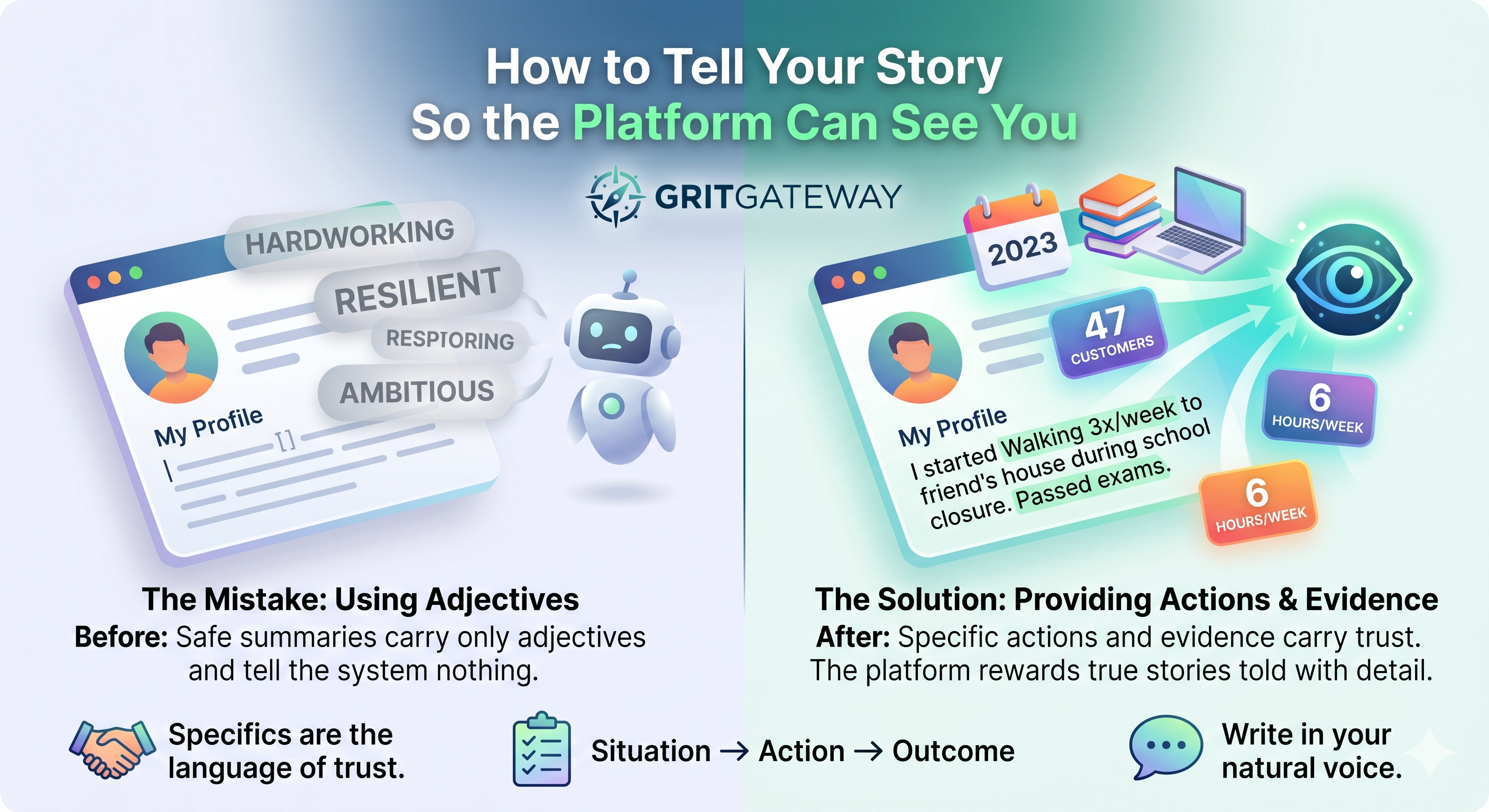
The first is specificity. Names, dates, numbers, places. A response that says "I once tutored some students" is doing nothing for you. A response that says "From January to April 2024, I tutored 12 students for 500 CFA per session and used the income to buy my first laptop" is doing a lot. The specifics are how we tell the difference between a real story and a description of the kind of person you imagine yourself being.
The second is behavioral evidence over self-description. Don't tell us you're resilient. Describe what you did when something went wrong. Don't say you're a leader. Describe the moment you stepped forward when no one asked you to. The system is reading for actions, not adjectives.
What the score isn't
Your GritScore is not a measure of your worth. It is not a prediction of your future. It is not a verdict on whether you'll succeed. It is a careful read of the evidence in your story right now, scored against a rubric that was designed to be fair across cultures and contexts.
The score will not penalize you for grammar, fluency, or polished writing. A short, clear, specific story scores higher than a long, eloquent, vague one. A first-language speaker writing complex sentences with no behavioral content will score lower than a second-language speaker writing simple sentences full of specific actions. The system reads past the writing and looks for what you did.
What to do with your score
If your score is high, you have evidence of strong patterns. Use that as a baseline, not a ceiling. The world will keep testing you, and the work continues.
If your score is moderate, the most useful thing you can do is look at the dimensions where you scored lower and ask: do I have stories that demonstrate this dimension, but I didn't tell them yet? Often the answer is yes. People underestimate what they have until they're asked specifically.
If your score is lower than you expected, the system is telling you something useful: the evidence you've shared so far doesn't yet make the case strongly enough. That's not a judgment of you. It's a signal about what to add. Update your story with more specific examples — what you did, when, with whom, with what result.
We re-score your profile every three months based on how you've engaged with the platform and any new stories you've added. Your score is a snapshot, not a sentence.
The point of all this
Grit isn't a number. It's a pattern of behavior that shows up over time. The score is just our best attempt to read that pattern from what you've told us. The more specifically you tell us, the more accurately we can read.
We built this for students whose stories don't fit the templates that scholarship and admissions systems were designed for. We're trying to do that carefully, and we'll keep improving how we do it.
Tell us your story specifically. Show us what you did. Let the score do the rest.